Top Signs You Need Garage Door Service – Don’t Ignore These
A door that takes three seconds longer to open than it used to isn’t a quirk. It’s the opener motor working against a spring that’s lost tension, and that combination burns out motors in weeks, not months. The most common mistake we see in Portsmouth is a homeowner waiting until the door stops moving entirely, by which point a small spring problem has become a motor replacement too. If you’d rather not diagnose this yourself, call (855) 937-1767 and we’ll take a look.
Key Takeaways
- Slow travel usually means spring tension loss, not a tired opener.
- Grinding is a worn drive gear, not a lubrication problem.
- An uneven floor gap points to a cable length issue.
- Run the balance test monthly: if the door won’t hold halfway, the springs are going.
- Noise ignored today often triples the repair bill later.
Why Your Door Is Talking to You in Plain Language
Garage doors are simple mechanical systems carrying enormous load. A torsion spring holds hundreds of pounds of door weight under constant tension, and the opener only does a fraction of the lifting. When something in that system starts to wear, the door tells you before it fails completely. The catch is that most homeowners read the symptom wrong. A grinding noise gets treated as a lubrication issue. A slow door gets treated as an old opener. Both guesses are usually incorrect, and both delay the fix.
We work on the door you already have, which means we diagnose the actual failure rather than jumping straight to replacement. In Portsmouth, that matters because our humidity season runs May through September, and it creates a specific pattern of failures that show up looking like alignment problems rather than weather damage. Seals swell, hardware loosens, and the door drifts out of true. Knowing which symptom maps to which cause is the whole game. Here’s how to read what your door is saying.
Symptom One: The Door Moves Slower Than It Used To
Slow travel almost always traces back to spring tension loss, not a failing opener. As a torsion spring fatigues, it holds less of the door’s weight. The opener compensates by working harder, which makes the door creep up and down more slowly. The dangerous part is that the motor isn’t built for that extra load. Left alone, an opener working against a weak spring can burn out its drive system or overheat its capacitor in a matter of weeks.
Push the opener button and watch the door from the side. A healthy door moves at a steady, even pace. A struggling door hesitates at the start or labors through the middle of its travel. That hesitation is your motor straining. If you catch it early, it’s a spring repair. If you wait, it’s a spring repair plus an opener repair. That’s a bigger job than it needed to be, and it’s the single most common pattern we see.
Spring repair is the highest-risk work on a garage door, and it’s not a homeowner job. Torsion springs stay under dangerous tension even when the door is down. A trained technician handles them safely with the right winding bars and technique. For this specific failure, our garage door spring repair service is the right call, and we treat it as a dedicated service rather than an afterthought. Our technicians have up to 15 years of experience reading exactly this kind of load stress.
Symptom Two: Grinding or Scraping When the Door Moves
Grinding is a worn drive gear, not a lubrication problem. This is where homeowners get tripped up most often. They hear a grinding opener, grab a can of grease, and coat the rail. The noise doesn’t stop because the gear inside the opener is stripped, and no amount of grease fixes a gear that’s lost its teeth. On a belt or chain drive opener, the plastic drive gear wears against the metal worm gear over years of use. Once the teeth round off, it grinds every time the door runs.
What to check, rather than what to fix yourself:
- Listen for the noise at the opener unit versus the door itself. Opener noise means the drive gear. Door noise means rollers or hinges.
- Look at the rail for metal shavings or dark dust. Both point to gear wear.
- Watch the door’s travel while you listen. If the grinding happens only in one direction, the gear is the likely culprit.
The reason this matters is that a worn gear gets worse fast. Once it starts grinding, it’s shedding material on every cycle, and the damage compounds. We service opener systems across the brands most homes in Portsmouth already have installed, including Genie and LiftMaster units, so we can diagnose the gear on the model you own instead of pushing a full replacement. Our garage door opener repair work starts with identifying what actually failed.
Symptom Three: An Uneven Gap at the Floor
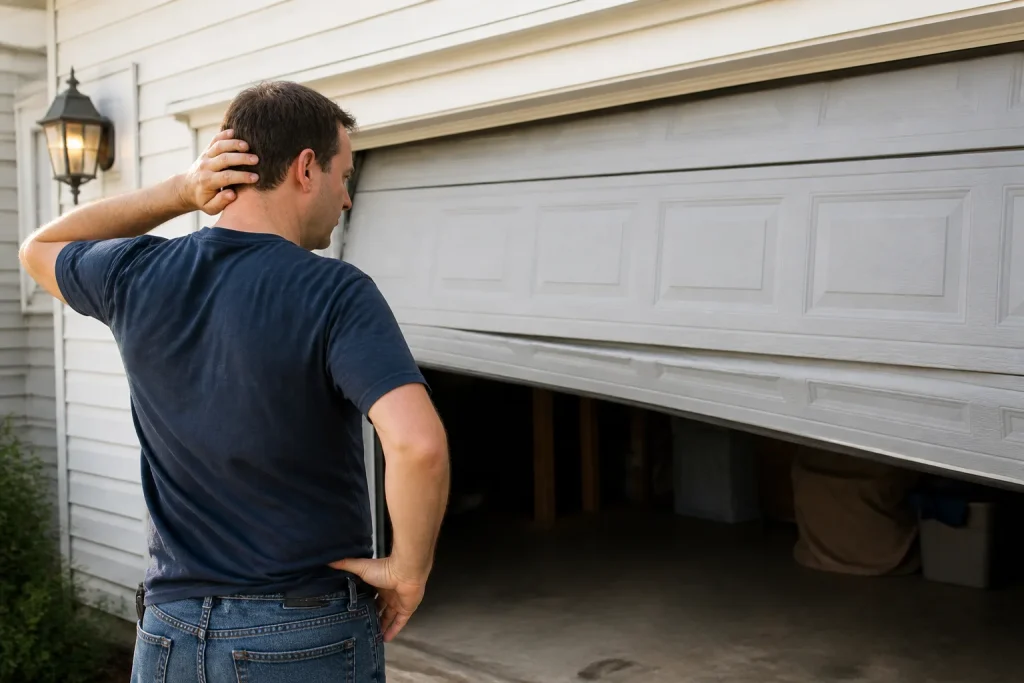
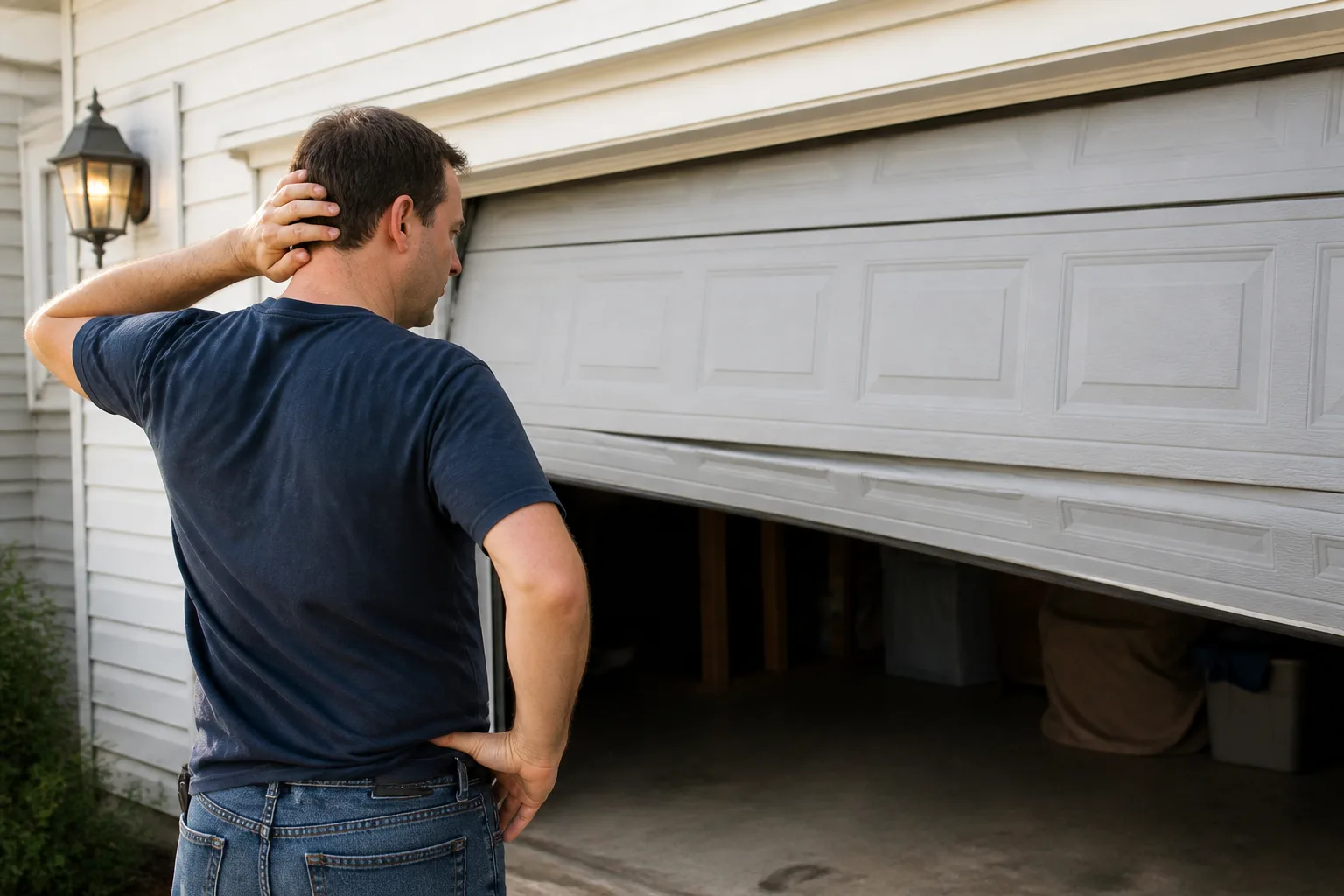
An uneven gap at the floor usually means the cables are no longer matched in length, and that’s a symptom worth taking seriously. Garage doors lift on two cables wound around drums at each end of the torsion shaft. If one cable has stretched, slipped, or come slightly out of its drum, the door lifts at an angle and leaves a gap on one side. You’ll notice light coming under one corner, or a draft you didn’t have before.
Sometimes the cause is simpler: a bent bottom bracket or a roller that’s jumped its track. But the cable length theory is the one that gets missed, and it’s the one with real consequences. A door running with mismatched cables is unevenly loaded, which wears the tracks and rollers faster and puts extra strain on the springs. In Portsmouth, the May to September humidity loosens hardware and swells bottom seals, so alignment complaints spike in those months. What looks like weather damage is often a cable or hardware issue that the humidity simply exposed.
Run a quick visual check. Lower the door fully and look across the bottom edge. A gap on one side only, with the other side flush, points to cable or bracket trouble. A gap that runs the full width is usually just a worn bottom seal. If it’s uneven, stop and get it looked at. For general repairs on any make or model, our garage door repair team works on Clopay doors, Amarr doors, Wayne Dalton doors, and the vast majority of systems already installed in homes around here.
Symptom Four: Jerky Movement or a Door That Shudders
Jerky movement points to a bent track or a roller with a flat spot. A healthy door glides. A door that stutters, shudders, or pauses mid-travel is riding on hardware that’s no longer smooth. Bent tracks happen when something strikes the door, when the door is pushed or pulled by hand, or when a roller seizes and drags along the track. Rollers develop flat spots from years of sitting in one position against a load. Both create that stop-start motion.
This is one of those signs that lets you schedule it this week rather than panic. A jerky door still opens and closes, and the risk isn’t immediate. But it’s also self-worsening. A flat-spotted roller chews into the track. A bent track wears out rollers faster. The longer it runs, the more parts it takes with it. Left long enough, a seized roller can jump the track entirely, and now you have a door hanging at an angle. That’s a stop-using-it situation, not a schedule-it situation.
When to Call a Pro
Some signs give you room to plan. Others don’t. Here’s the dividing line:
- Schedule this week: slow travel, grinding, jerky movement, a full-width gap at the floor.
- Stop using the door today: a door that hangs at an angle, a snapped spring, a cable that’s visibly loose or off its drum, or any door that won’t open or close fully.
If it falls in the second category, don’t force it. A door stuck open compromises security, and a door stuck closed cuts off your access and your vehicle. When the door won’t move, we move fast on emergency service. Call (855) 937-1767.
The Monthly Test That Catches Spring Failure Early
There’s one test every homeowner should run monthly, and it takes about a minute. It’s the balance test, and it tells you whether your springs are doing their job. Close the door, then pull the manual release cord to disconnect the opener. Lift the door by hand to about waist height and let go. A healthy door holds its position on its own. A door with failing springs drops or won’t stay put. Reconnect the opener afterward by hand-cycling the door to reset the carriage.
What result means the springs are failing: if the door falls from the halfway point, or if lifting it takes real effort, the springs have lost tension. Don’t keep testing it beyond that, and don’t try to fix it. A failing spring is under heavy tension, and this is the one part of a garage door that can seriously injure someone who handles it without training. Our technicians have up to 15 years of experience on springs specifically, and we treat a balance-test failure as a prompt for a spring inspection.
Why Ignoring a Noisy Opener Is the Most Expensive Mistake
A noisy opener is the most expensive warning sign to ignore, because the damage it causes compounds. What starts as a grinding drive gear spreads. The opener overworks trying to move a door with a weak spring, and the drive system takes the load it wasn’t designed for. By the time the opener quits entirely, you’re not just replacing a gear: you may be replacing the motor and the springs together. That’s the repair bill that triples.
We’d rather fix a gear today than sell you a new opener next month. Our approach is brand-agnostic, driven by what your existing system needs rather than what parts happen to be on hand. We’re factory-familiar with eight major brands including LiftMaster, Chamberlain, Genie, Clopay, Amarr, Wayne Dalton, Craftsman, and Raynor, so we can work with the door and opener you already own. From an opener glitch to a full installation, you don’t need to call a second company. One call covers the diagnosis through the repair.
Have a look at the rest of what we handle in Portsmouth at Portsmouth Garage Door Repair Pros, then get us out to look at the door that’s been making noise.
Related Services in Portsmouth
Depending on what your door is telling you, the fix may be a targeted repair or a closer look at the opener. Our garage door opener repair and garage door spring repair pages cover the two most common failure points in detail, and our garage door repair service handles everything from rollers and tracks to cable and hardware issues.
What happens when you call
- 1
A real person answersNo phone trees – you reach a local pro.
- 2
You get an upfront price rangeHonest numbers before anyone is dispatched.
- 3
A background-checked tech heads outLicensed & insured, dispatched right away.
- 4
You approve before work beginsNothing starts until you say go.
The Bottom Line
Your door’s warning signs aren’t subtle, and each one maps to a specific failure that gets more expensive the longer it runs. Slow travel means spring tension loss. Grinding means a worn drive gear. An uneven floor gap means a cable length problem. Jerky movement means a bent track or a flat-spotted roller. Run the balance test monthly, and stop using the door the moment it hangs at an angle or a spring snaps. Catch it early and it’s a straightforward repair. Wait, and you’re paying for the mechanical damage plus the original problem.
If you’re in Portsmouth and need help, Portsmouth Garage Door Repair Pros offers free estimates. Our technicians have up to 15 years of experience on spring repair, opener repair, and full installation across the brands most homes here already have. We work on the door you have and quote the price before any work starts, so there are no surprises on the bill. Call (855) 937-1767 today.
Frequently Asked Questions
A broken torsion spring usually makes a loud bang, and the door becomes too heavy to lift by hand or won’t open at all. Run the balance test: pull the manual release, lift the door to waist height, and let go. If it drops instead of holding, the springs have failed. Stop using the door and call (855) 937-1767 for a spring inspection.
It’s not immediately dangerous, but it’s the most expensive sign to ignore. Grinding means the drive gear is wearing, and it gets worse on every cycle. Wait too long and the opener fails entirely, often taking the springs with it. Catch it early and it’s a gear repair. Call (855) 937-1767 for an exact quote, and estimates are free.
No. A door hanging at an angle means one cable has slipped or the door is unevenly loaded, and forcing it can cause a roller to jump the track or a cable to snap. Stop using the door and call (855) 937-1767 for emergency service.
Once a month. It takes about a minute and catches spring failure before it strands your car or burns out the opener. If the door won’t hold halfway, the springs are failing and need professional attention. Call (855) 937-1767 to schedule a free estimate.
Written by the team at Portsmouth Garage Door Repair Pros.
Need Garage Door Help?
Call Portsmouth Garage Door Repair Pros - the local pro we connect you with is licensed and insured, here with fast after-hours help in Portsmouth.
(855) 937-1767